Thursday, June 20, 2013

Re: Why the name Louisiana?

Thanks, Marc, for the enlightenment. Cool story, even if not substantiated. I will forward this to my Danish friend.

Mike

On Thursday, June 20, 2013, Marc Raizman wrote:
Dear Michael:  You missed a piece of "dirt" following your visit to the above museum. The story, as I was told when we visited the place,was that
Alexander Brun, the museum founder, had three wives and they were all named Louise.

In Italian there is a saying, "Si non e' vero, e' bene trovatto."
If it isn't true, it is a good story.


Sorry to hear that you are about to lose your satellite connection because of your ship's northerly location.

Best,  Marc Raizman

A great city with a gracious native


Thursday – 20 June 2013 – At Sea 58N 10E, off the northern tip of Denmark

We cast off the dock of Helsingborg, Sweden just before 3pm on Tuesday afternoon with help from a tug to thread through the narrow breakwater. Helsingborg is a busy ferry port with large car and truck ferries coming and going every few minutes for the 20 minute crossing of the Oresund Narrow to Helsingor, Demark. Since Silver Cloud's maneuvering took about a half hour, I suspect that cascading delays on the ferry schedule will not be resolved until the Christmas break. No matter to the locals (except for those who missed their train connections). We had a large audience for our departure. Silver Cloud's call at this port in Sweden was a big deal. Cruise ships are usually much too large to dock at Helsingborg.

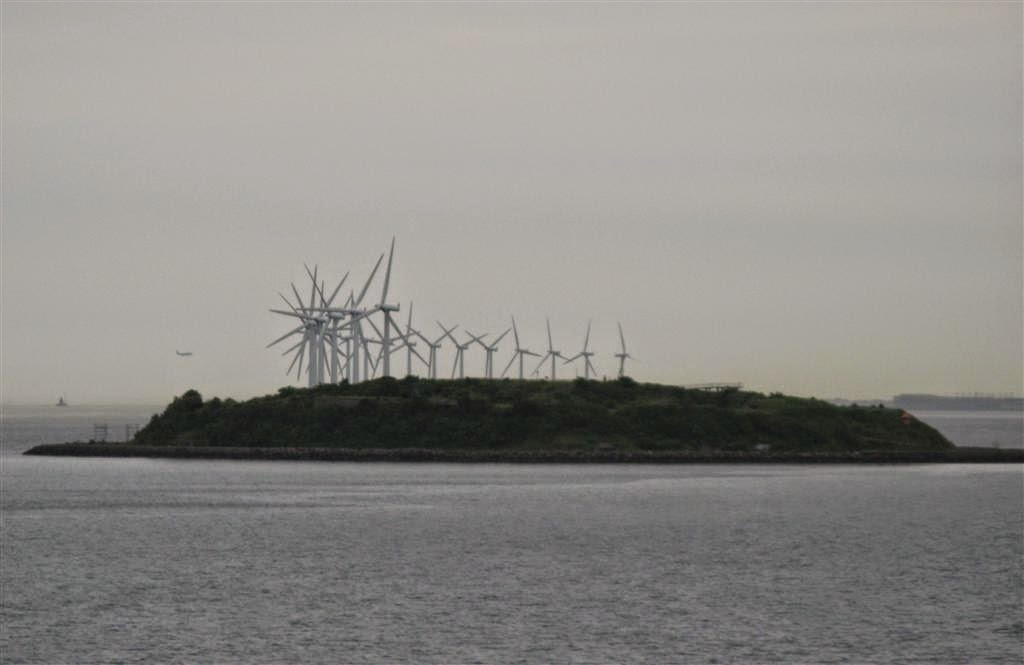
The couple of hour's transit to Copenhagen was quite lovely. We caught a glimpse of "Elsinor" castle of Hamlet fame, actually Kronborg Castle just outside of Helsingor. I could almost hear Ophelia jumping over the cliff, or was it drowning in a river. I forget. Barbara and I stayed up at the bow in sunny and windless conditions as a following wind matched our speed. We passed the iconic line of wind turbines out in the Copenhagen harbor, the first such off-shore facility I had seen years ago during my last cruise from this port, and we were docked shortly after.

We stayed on deck for the arrival in Copenhagen hoping to see our friend Jannik, a Copenhagen native, but a broad smile indicated that he saw us before we saw him. We joined Jannik on the pier as soon as the ship was cleared by the local authorities. Jannik had a wonderful evening planned for us. Somehow knowing our preferences, he came prepared with 24 hour passes for the Copenhagen transit system, tickets for Tivoli, and dinner reservations. We had a delightful evening in the wonderful prototype 175 year old theme park and even took in a classical ballet/pantomime show near the restaurant Jannik had chosen in the park. After an after dinner Carlsberg or two watching the lights come on in the park we walked back to the classical central railway station for our short train ride back to ship. A wonderful evening, indeed.

We met Jannik on the pier at 9:30am yesterday morning for a full day exploration of Copenhagen. Although I had been here before a number of times, this was the first visit for Barbara. Near where Silver Cloud was docked we walked through the throngs of tourists, souvenir stands, and tour groups gawking at the Little Mermaid statue. After some time and considerable patience I was able to take a photo of the "Copenhagen's Number 1 Tourist Attraction" as the souvenir stand's sign said without getting a bunch of tourists taking pictures of mostly each other.

Our exploration of Copenhagen covered the Crown Prince's Palace where a shift change of the guard was occurring, the whimsical old stock exchange with its steeple of dragon's intertwined tails, and just about every other sight in this most livable and enjoyable city. Of course, a tour led by a native can not be beat. So nice not to have my head buried in a map.

We ventured back to the railway station for the half hour ride up to Louisiana, the curiously named modern art museum, for lunch with a lovely view across the water to Sweden after enjoying oddly enough a very nice retrospective of Yoko Ono's artistic career.

We bid goodbye to Jannik on the train at the port and thanked him for a fantastic visit. We most likely will see him on a future cruise. Of course, we offered to reciprocate in Boulder or somewhere else in the States. Jannik travels extensively and we most certainly hope he takes us up on our offer.

As yesterday was the "turn around day" on our two segment cruise, we checked out the newcomers at tea time. They seemed a jovial fun loving group. (See picture above at tea). Then we joined the now every segment mandatory safety briefing. This is held on Silver Cloud in the small Panorama Lounge. As crowded as the short briefing was, it was gratifying to realize that this small throng comprised all the passengers and most of the crew on this tiny cruise ship. 

Tuesday, June 18, 2013

An overlooked ferry port


Tuesday – 18 June 2013 – Helsingborg, Sweden

I visited Helsingborg about 20 years ago just long enough to run from the slightly delayed train from Stockholm to board the ferry to Denmark. So I didn't get to see this quite lovely town until this morning's half day port call. And we were no longer in Germany.

We arrived before 8 am adjacent to the very busy Helsingborg ferry docks for our cruise's only stop in Sweden. The view from Silver Cloud of the town square was promising although the tourist information didn't really list a bunch of "must sees". It was kind of fun to see Kronborg Castle in Denmark across the Oresund Strait. Kronborg is the setting for Hamlet, of course, and a tourist destination right up there with visits to the buildings in Cleveland used to film Jean Shepherd's, "A Christmas Story", or for that matter Mork and Mindy's house in Boulder. But the view from Helsingborg was quite nice. As it happens, Helsingborg has a nice castle of its own. So there!

On the way to check out the 7-11 store at the railway station—where else—we observed a peasant on a bicycle and bunches of little kids in safely gear being led to look at Silver Cloud. We later found out that cruise ship calls are quite rare in Helsingborg, and our visit was highlighted in the local newspaper. I was amazed. There still are newspapers?

Another bombed to smithereens but restored Hanseatic League town and an octogenarian beach resort


Monday – 18 June 2013 – Warnemunde Port and Rostock, Germany

The most important city/state in the Medieval Hanseatic League was Rostock in modern Northern what used to be East Germany. In the 15th and 16th Centuries, traders in Northern Europe controlled many areas. It was not good to mess with these characters, but they sure built pretty houses.

Upon docking in the seaside resort of Warnemunde, Barbara and I hot footed it the 100 feet or so to the train station conveniently visible from our window on the ship. The S-Bahn commuter trains run every 20 minutes for the 20 minute ride to the downtown Rostock Central Railway Station. The 4.60 euro day pass also included the connecting tram line which we took to the stately University Square to "do" our own walking tour. So we paid about $10 total for the two of us and gloated at the Silversea shore excursion groups where each participant had put down $99. We kept coming across the group—their guides were using the same map—and might have heard the narration from their tours guides had we walked as slowly as they did.  But of course we had the brochure with the text. Boy, do we know how to do this sort of thing!

From Rostock's University Square we took pictures at the pretty nifty Town Hall. (Compare and contrast Boulder's square unadorned city building where there's homeless people lounging where the apparently forgotten front door should be).  We photographed the meticulously—hey, it's Germany—restored Hanseatic houses and visited the Medieval St. Mary's Church which has the highest ceiling I've seen and a very impressive Astronomical Clock. The clock is said to be operating continuously since the 1400s, but apparently not quite perfectly since it claimed that the current year was 1952. Also, the "perpetual clock" which originally started in 1489 or so had a revised start date of 1889 and perhaps more disquieting, an end date of 2017. The end of time? No matter, it was a very impressive accurate clock—the time appeared correct. Those Hanseatics must have anticipated Daylight Savings Time.

After what was a quite pleasant few mile walk around historical Rostock we returned to the ship via the efficient S-Bahn, had lunch, and then decided to explore Warnemunde where we had docked. I was surprised to see a modern and quite busy ocean front resort town, a very crowded beach (including an enterprising kite maker displaying his work), some whimsical park statues, and a very tacky snack bar. Just like similar places in the USA, but Barbara and I seemed to lower the average age of the beach goers by a good 10 to 15 years, and the few groups of teenagers around sat quietly on benches and tried to practice their English on us. Maybe a short visit isn't enough to truly understand a place.

Monday, June 17, 2013

A “land cruise” and how the Kiel Canal made the trip more than worthwhile!


Sunday – 16 June 2013 – Kiel Canal

I felt no remorse as Silver Cloud cast off and left the downtown Hamburg under construction cruise port at 8am.  We sailed down the Elbe River for a couple of hours, mostly watching multiple gigantic container ports go by. Hamburg is one of the largest port areas in Europe and certainly the largest in still prosperous Germany. Oddly enough, the ports are hours sailing from the North Sea. I'm sure there's a good explanation. Unfortunately I don't know it.

Just before reaching the sea, however, we entered the lock to be raised about a meter to transit the Kiel Canal. The 92 kilometer long ditch across Utland saves ships 250 miles of sailing around Denmark in the sometimes torturous waters of the North Sea. Instead the ride is a smooth and unbelievably scenic "land cruise". By some measures the Kiel Canal is considered the busiest artificial waterway in the world. We passed dozens of fairly large ships going the other way.

The Hamburg end of the Canal is quite industrial. We sailed by a very chemical plant looking aspirin factory and various other appropriately serious sites, but in less than a half hour we were riding through woods and pastures and listening to birds signing or cow bells ringing respectively. 

The Canal is only 90 meters wide at the bottom, 162 meters at the waterline. Although most ships can pass each other without delay, lock operations and the occasional bigger freighters require that "meets" be made at designated points. I was amazed to see the canal pilot controlling Silver Cloud at one of these pullouts, in a driving rain no less. Our Captain was no doubt observing from inside the bridge, but I suspect he would much have preferred that he wasn't required to relinquish operating the controls. I knew that the Panama Canal requires that this happening, but I was quite surprised to see that the Master was not driving his own ship in the Kiel. So was the Captain, I suppose.

Barbara and I spent the entire eight hour transit on deck watching the fields and towns go by. As this was a Sunday, the locals were out for a good time. In Northern Germany that usually amounts to eating at country inns and scowling and/or waving madly at passing cruise ships.

We had been briefed by the ship's Destination Lecturer, Corey, that we would see towns, fields, pastures, and some industry along the canal. He also told us that we would see what appears to be the world's longest bench. After taking a bunch of photos of this magnificent structure that could rest more people than live in all of the German state of Mecklenburg, we came across the sight that would FOR ME be the most memorable wonder of the entire cruise, at least so far. Under a railway bridge I spotted what looked like another of the numerous ferries that cross the waterway. However, it became clear from the support cables that this was indeed a Transporter Bridge. These structures were built by the 100s during the turn of the previous century. They are essentially ferry decks that are suspended a few feet above a river and carry people and vehicles across. Propulsion is by a winch arrangement controlled by the operator in a small "pilot" house on the deck.

I knew of three Transporter Bridges still in operation, in Middlesbough in England, Newport in Wales, and near Bilbao, Spain. This one in northern Germany was a complete surprise. The Captain must have enjoyed seeing this wonderful device as he tooted the ship's whistle as a salute. Perhaps that was because as he wasn't allowed to drive the ship maybe he just wanted to show he could still blow the horn, now that I think of it.

We exited the canal about 10 pm in sunlight and sailed the rest of the night finally in the ocean as we had now transited from the North Sea to the Baltic to arrive early Monday in Warnemunde, our last stop in Germany. 

Correction

I know there are a few typos and misspellings in this blog (as usual). I will repair the text when we return home or find a nice leisurely and free Internet access later in the cruise. Meanwhile I do apologize. I do want to correct right away provide the correct spelling for Hanseatic. I will be saying more about this trade organization that established a number of cities in northern Europe. Today we visited Rostock, with its somewhat restored rows of characteristic buildings, and next week we will be in Bergen, another place to find fine examples of the distinctive shops and warehouses. 

Saturday, June 15, 2013

Down the Amstel and Up to the North Sea, Then Up the Elbe and Down to Hamburg


Saturday – 15 June 2013 – Hamburg, Germany

After dinner on Thursday, Barbara and I ventured back out into Amsterdam to see this most wonderful of cities all lit up after dark. As predicted, it never got dark enough for the lights to come on. But we did get to use our transit passes once more and had a really nice walk back to the ship. 
Did I mention that Amsterdam is a very nice place to spend a day or two? Maybe more.

We cast off the downtown Amsterdam pier just before 8 am yesterday morning. The commuter trains were going all out (well actually in) to the iconic downtown Central Station. We sailed downstream on the Amstel River for almost two hours before reaching the set of locks to the North Sea. The Captain threaded our ship skillfully in a stiff breeze into the barely wider lock chamber. As the tide was coming in, we were RAISED about a meter up to sea level, the Netherlands truly being the "low country" as most of the country is below sea level. The levee industry is huge in this place. So are the levees.

After the lock, as we entered the North Sea after passing some spectacular beaches. It occurred to me that since crossing the English Channel late Sunday evening, yesterday's afternoon and transit along the Holland and German coastline to the mouth of the Elbe River was the first true ocean we were sailing on during this mostly river cruise. We spotted a cargo ship delivering wind turbine propellers, a most usual sight, but never actually felt any movement of the ship as the seas were quite calm.

We entered the very industrial Elbe River about midnight this morning and sailed the 138 kilometers upstream to as the tour brochure claimed, "The Hanseatic Gem of Hamburg". We were on the first shuttle bus to Rathaus Squre, the center of the old walled city. The town hall is indeed spectacular, by far the nicest thing we saw all morning as the cruise port is a huge construction site. 

We made our way through the undistinguished downtown shopping district to the 1906 railway station (as is our wont) and discovered that a "hop on/hop off" red bus was about to leave on a pretty comprehensive tour of the city. Again, here we saved about $120 by not purchasing the virtually identical ship's tour. Good thing as Hamburg was kaputmachen pretty completely during WW II. Except for the aforementioned Rathaus, everything else was either reconstructed from rubble or replaced in the 1950s by, uh, 1950s style buildings. 

We did see a couple of down and out Hanseatic style facades and the restored 1700s riverfront warehouses, but otherwise this probably pretty functional city doesn't appear to me to be a major "must see" European destination.  

What made the tour memorable, however, was the curious live narration. The young woman who was the upper deck guide on our bus presented the sights in a style that can best be described as over the top, demeaning, and histrionic. Quite a combo. She made Jay Leno's style of put down humor seem very tame as she described every snack product or confection of the area as if she had not eaten in two or three years, pointed out fairly nondescript large houses as "billionaire's palaces", and went completely gaga over the two kind of sad looking urban lakes that are the pride of the Hamburgerites. 

I expected a bit of pandering when the bus diverted its circle tour to take in the famous St. Pauli red light district. But our fraulein went completely non-linear as she proceeded to make fun of every male on the sidewalk, mocking them to the passengers, and as they looked up and noticed the bus passengers hollering at them, she tried to embarrass them further as we went by. Oddly enough, St. Pauli is also a restaurant and legitimate hotel district. So many of the people on the street were shop keepers, waiters, or tourists. Thinking that they must know this docent, some of the shopkeepers waved back, and the mostly all German tourists on our bus laughed uncontrollably and snapped lots of pictures.

At the end of the 90 minute circuit of the city, the guide announced that a "coin plate was available for any rewards for enjoying my narration." I thought about pocketing two euros. Seemed about right.